1800K — Candlelight
The warmest light most people ever sit under
1800K is firelight. It is deeply amber, very low in blue content, and flatters skin while washing most other colors toward orange. Used as an accent it feels intimate; used as a room's only light source it feels dim even when it is not.
Open 1800K in the visualizer- CIE 1931 x
- 0.5496
- CIE 1931 y
- 0.4081
- Locus
- Planckian (black body)
- Category
- Ultra Warm
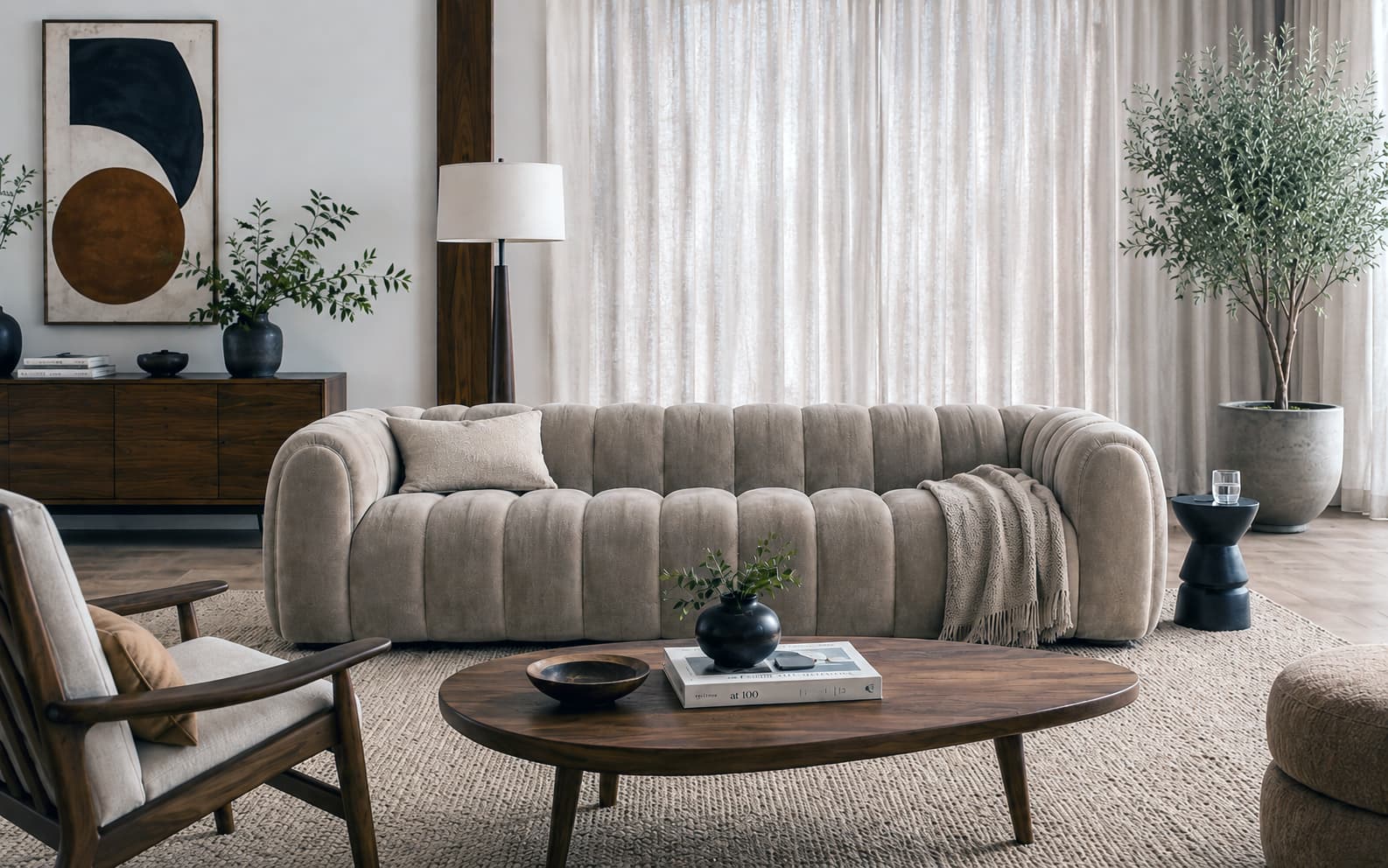
1800K in four rooms
What it does well
- Deeply relaxing — the single most effective temperature for winding down a room
- Extremely flattering to skin tones; reduces the appearance of blemishes and redness
- Almost no blue content, so it interferes least with evening melatonin production
- Creates strong visual hierarchy when used as an accent against cooler ambient light
- Hides dust, imperfect finishes and worn surfaces better than any other temperature
What it costs you
- Renders blues, greens and teals as dull grey — actively bad for anything color-critical
- Reads as 'dim' even at high output, so rooms often need more fixtures than expected
- Whites turn distinctly orange, which looks dirty on painted trim and linens
- Very few general-purpose fixtures are made at this temperature; usually needs dim-to-warm or specialty lamps
- Mixing it with 4000K+ in the same sightline looks like a mistake rather than a choice
In practice
At 1800K you are essentially looking at a flame. A wax candle sits near 1850K, a low-burning fire a little under that, and a filament bulb dimmed to the bottom of its range lands here too. The spectral output is dominated by long wavelengths, so reds and oranges glow while blues and greens go muddy and grey.
This is the temperature that made 'warm dimming' a selling point. Ordinary LEDs hold their color temperature as they dim, which subtly breaks the association everyone has between low light and warm light. Dim-to-warm LEDs deliberately slide toward 1800K at the bottom of their range to recreate the incandescent behaviour, and the effect on a room's atmosphere is disproportionate to the technical change.
Because the eye's sensitivity shifts toward blue-green at low light levels (the Purkinje effect), a very warm source at low output can read as dimmer than a neutral one of identical measured brightness. Plan for more fixtures at lower output rather than fewer bright ones.
Mood
Intimate, hushed, celebratory. This is the light of a dinner that has gone on too long in the best way.
Sleep & alertness
The safest temperature for the two hours before sleep. Melanopic content is very low, so it does the least to suppress melatonin.
Color rendering
CRI is nearly meaningless as a single number down here — the reference illuminant is itself a black body at 1800K. Look for R9 (deep red) values and, if available, TM-30 Rf/Rg rather than trusting CRI alone.
How it feels: Flame-like, deeply amber, almost no blue content.
Want to see 1800K in your own room?
The photo tool re-renders a picture of your space at this exact temperature, in your browser.
Open the photo tool